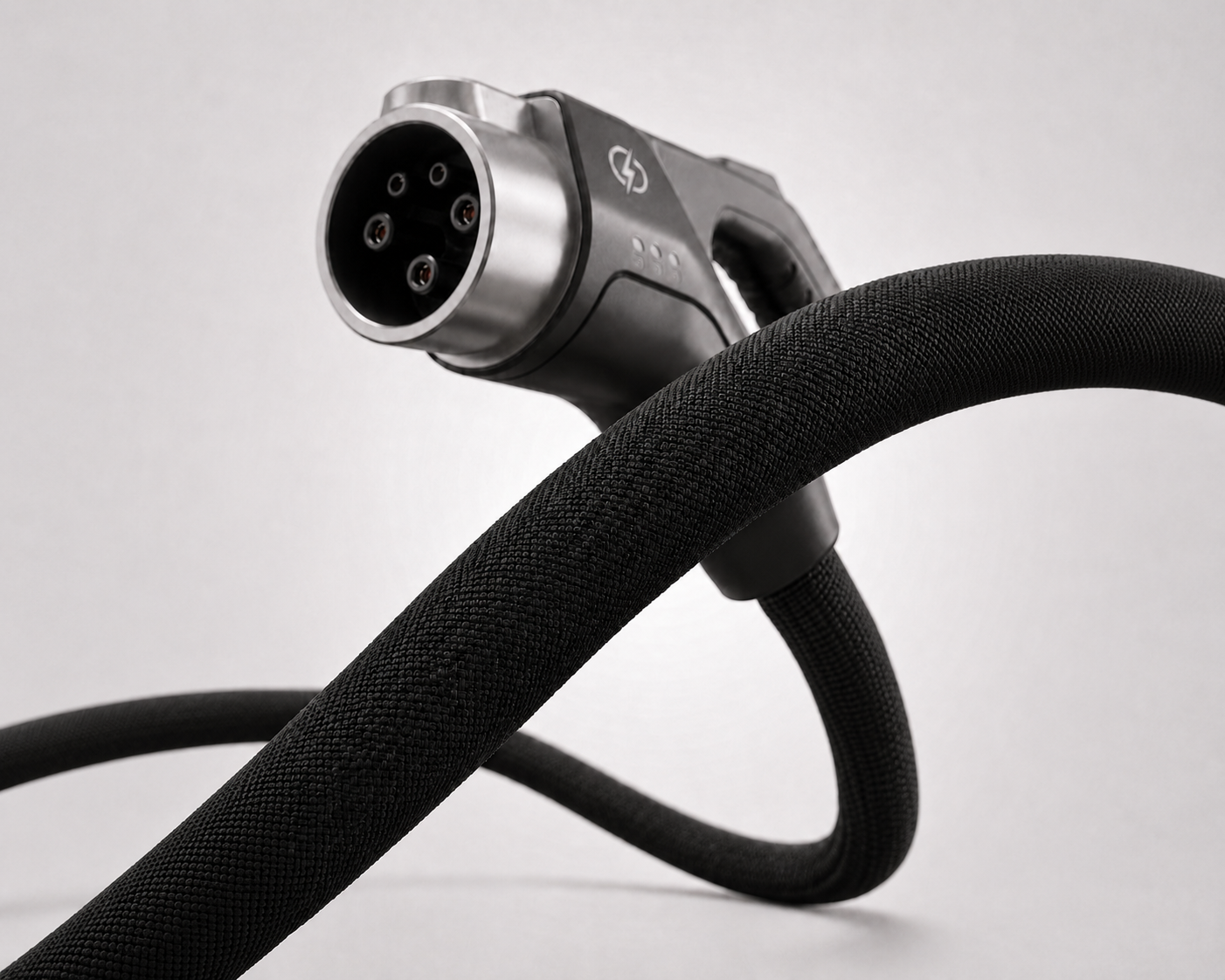
Reinforced Cable Protection System

Keep the
flow secure.

VoltArmor is a field-installable protective sleeve system for EV charging cables — combining UHMWPE fabric and integrated steel wire ropes to resist cutting attempts and deter theft.

8×
Steel wire ropes
5m
Cable length
VoltArmor sleeve — outer protective flap detail VoltArmor sleeve — inner layer cross-section VoltArmor sleeve — zipper closure detail VoltArmor — dual zipper system
Tested for
Enel S.p.A — Feb 2026
Cut-Resistant Protection8 Integrated Steel WiresUHMWPE FabricField InstallableTested for Enel S.p.ADual-Layer System37.5mm Cable DiameterZipper ApplicationCut-Resistant Protection8 Integrated Steel WiresUHMWPE FabricField InstallableTested for Enel S.p.ADual-Layer System37.5mm Cable DiameterZipper Application

A €3,500 problem
sold for €40
of copper

EV charging cable theft has exploded globally, driven by rising copper prices and a critical risk-reward imbalance. A thief can sever a standard charging cable in seconds with a bolt cutter — extracting ~€40 in scrap copper while leaving operators with €3,500 in damage, downtime, and replacement costs.

Insurance companies now classify these incidents as high-risk recurring losses. With over 15 million public EV charge points globally and the number accelerating, operators urgently need a retrofit-ready solution.

€3,500
Average cost per theft incident — cable + downtime + labor

Where it's happening

Theft clusters wherever fast-charging infrastructure meets low overnight surveillance.

Germany
EnBW reported 900+ incidents across 130+ sites. Up to 70 stations taken offline in a single day.
UK
Vandalism up 100%+ in two years. Cambridgeshire, South Yorkshire, and Nottinghamshire lead.
USA
Cable theft up 300% in three years. NEVI-funded infrastructure expansion accelerating exposure.
India
Organized overnight operations in Chandigarh, Hyderabad, and Delhi causing millions in rupee losses.

VoltArmor
Protection
System

Designed and developed by Kavi Design & Engineering Studio, VoltArmor is a multi-layer textile sleeve that wraps around standard EV charging cables — adding meaningful cut resistance without requiring cable replacement or specialized tools to install.

The system combines a UHMWPE outer layer with eight longitudinally-spaced 3 mm steel wire ropes, enclosed in a dual-zipper sleeve with stainless steel end clamps and locking connector covers.

Core Layer
🧱
UHMWPE Fabric
Ultra-High Molecular Weight Polyethylene outer sleeve provides exceptional cut resistance against hand tools. Flexible, lightweight, and weather-resistant.
Durability
🔩
Steel Wire Ropes
Eight integrated steel wire ropes distributed around the circumference force attackers to cut through metal before reaching the cable — maximizing time-to-breach.
Dual Layer
🧅
Inner + Outer Sleeve
A layered construction with inner wrap and reinforced outer sleeve creates redundancy — no single cut compromises the full system.
No Downtime
Field Installable
Zipper-based application installs on existing cables without removal or station downtime. No special tools needed beyond a standard socket for end clamps.
End Caps
🔒
Stainless End Securing
Stainless steel clamps and locking protective covers secure both cable ends, preventing sleeve removal and protecting the connector junction.
Standard
📐
37.5mm / 5m Ready
Designed for the most common EV fast-charging cable diameter and standard 5 m lengths. Custom sizing available for OEM integration.

Technical
Details

Cable diameter
37.5 mm
Cable length
5 m (standard)
Outer material
UHMWPE-based fabric
Steel wires
8 × 3 mm diameter
Clamps
Stainless steel (socket-tightened)
Fastening
Dual zipper + Velcro outer flap
Installation
Field retrofit — no cable removal
End protection
Locking connector covers

5 Steps. No Downtime.

01
Wrap inner sleeve around cable
Open the inner sleeve and wrap it around the EV charging cable along its full length.
02
Guide zipper around connector
Route the zipper around the EV connector end and pull along the cable to close the inner sleeve.
03
Apply and close outer sleeve
Slide on the outer protective sleeve, close the outer zipper, and fold down the protective flap.
04
Clamp and tighten ends
Position stainless steel clamps at both cable ends and tighten securely with a standard socket.
05
Lock connector covers
Attach the protective cover at both ends until it locks. Repeat for the opposite end.

Tested.
Proven.
Deployable.

Cut-resistance test conducted for Enel S.p.A.

Formal durability testing was conducted on a 37.5 mm cable surrogate against the two highest-risk attack tools: cable cutters and an angle grinder with a steel cutting disc.

Configuration A — eight 3 mm steel wires — was selected as the optimal balance of protection, weight, flexibility, and installation practicality. Three configurations were prototyped and evaluated.

Primary Threat
Cable Cutter
Most common theft tool. VoltArmor showed limited progression — steel wires defeated bolt cutter leverage.
Primary Threat
Angle Grinder
Highest-risk tool. VoltArmor significantly increased time-to-breach vs. unprotected baseline.
Secondary Threat
Hand Saw
Requires sustained access and stable fixturing. Reinforcement adds substantial delay.
Secondary Threat
Electrician's Scissors
Designed for soft insulation. Showed minimal progression against reinforced assembly.
Tool Penetration Resistance
Relative time-to-breach comparison (higher bar = greater VoltArmor resistance)
Electrician's ScissorsMinimal progression
Cable CutterLimited progression
Hand SawSignificant delay added
Angle GrinderMeaningfully increased vs. unprotected

Who needs
VoltArmor

The strongest B2B case is operators who've already experienced theft — a single cable replacement costs 2–4× the price of protecting it.

Charging Network Operators
One procurement decision reaches thousands of locations. The clearest ROI: a single theft event recovers the product cost many times over.
Municipalities & NEVI Recipients
NEVI program covers 80% of installation costs. Recipients need to protect that federal infrastructure investment — the exact VoltArmor pitch.
Insurance & Institutional
Insurers classifying cable theft as high-risk recurring damage can mandate or incentivize VoltArmor — turning the product into a near-requirement for coverage.

Documentation

Download the official product brochure or the full cut-resistance durability test report conducted for Enel S.p.A.

Ready to protect
your infrastructure?

Request a sample kit, technical data sheet, or a copy of the durability test report. We work directly with operators, procurement teams, and OEM partners.

Designed & developed by Kavi Design & Engineering Studio